
Signal Issue #09: The right model for the job
TL;DR
What a business should pay for AI depends on the value of the task, not the power of the model.
The best models are expensive and scarce. Using them for routine work either wastes money or leaves you queuing behind buyers willing to pay more.
Companies need a control plane to send each task to the cheapest model that does it well.
As models get cheaper, value is likely to shift to the company-specific context that makes them reliable. Gartner forecasts the AI context platform market to reach $78 billion by 2030.
Most news about AI is about the "frontier": the most powerful system, and the race to build it. That is like judging the car industry by Formula One. It tells you who is fastest, not what most people will drive or pay.
This note argues that what a business should pay for AI depends on what the task is worth, not on how good the model is. The best models are scarce, so they go to whoever values them most. That is why companies need a control plane to send each task to the right model, and why the knowledge that makes cheaper models good enough is becoming valuable in its own right.
A few terms first.
Compute: The chips and data centres that run AI models. There is only so much of it, and it takes years to build more.
Control plane: Software that decides, for each task, which model does the job, how much can be spent and what checks apply.
Context: The information a model is given about a specific company or task, such as its approved claims, terminology and rules.
All figures are in US dollars.
The Pareto frontier
Imagine comparing mobile phone plans. Plan A costs $30 a month for 10GB of data. Plan B costs $40 for 5GB. No one should choose Plan B, because Plan A is cheaper and gives you more. Cross out every plan beaten like that and the short list left is the Pareto frontier.
Do the same with AI models, using price and test score. A June survey of 351 priced models found only 13 on the frontier.
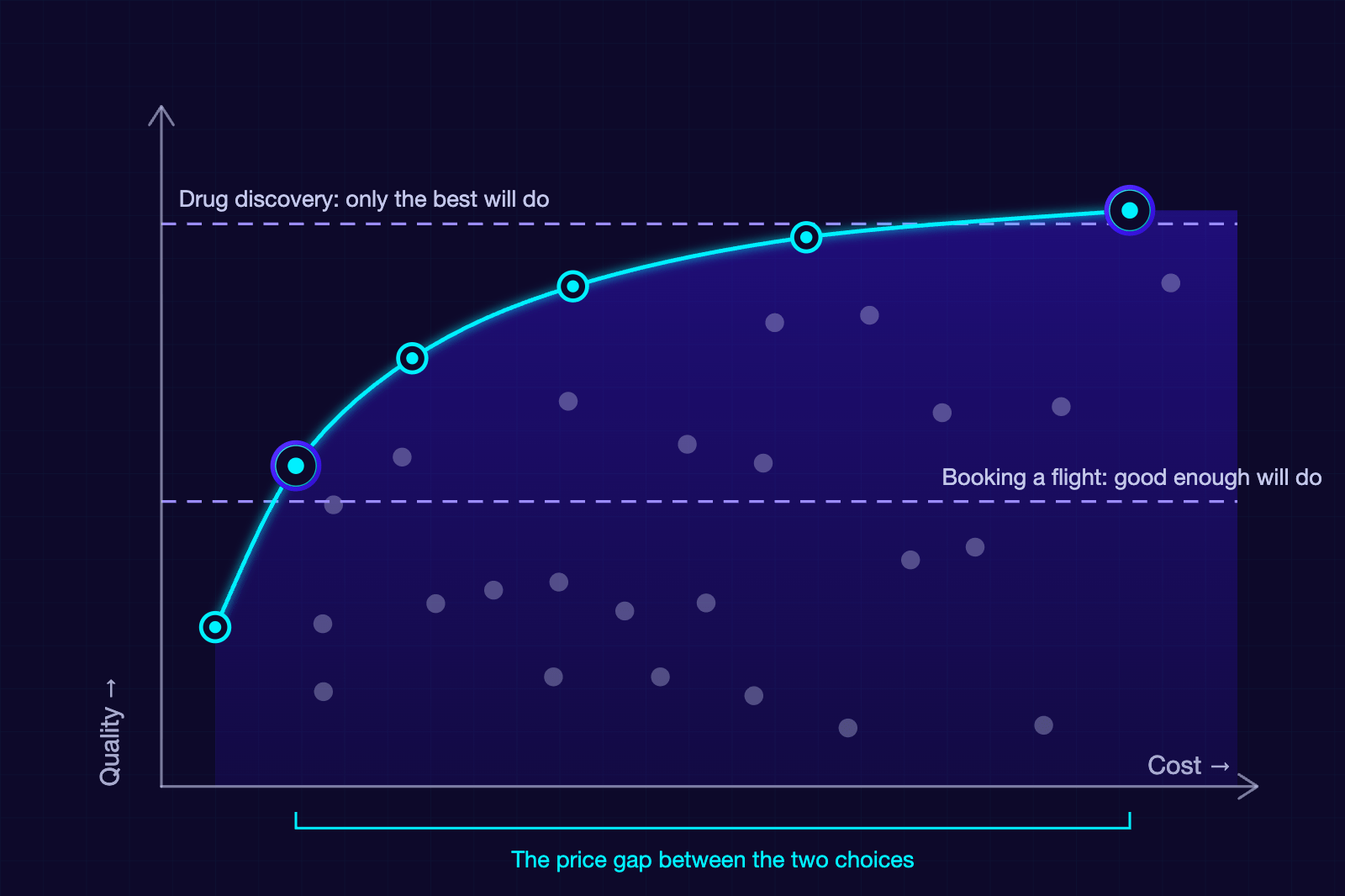
The frontier tells you which models are worth considering. It does not tell you which one to use. That depends on two things the model knows nothing about: what a right answer is worth, and what a wrong one costs.
Two facts matter. First, the last bit of quality costs the most. In one survey last month, a model scoring about 76 out of 100 cost $3.75 per million tokens (about 750,000 words); a score of 81 cost $20. Second, the whole frontier is getting cheaper very quickly. Epoch AI, an independent research group, finds the cost of reaching any given score has fallen about 13 times a year since 2023. The result is a very expensive peak that keeps moving, above a base that is getting cheaper fast.
The value is in the task, not the model
Consider two jobs at a drug company on the same morning. The first is in its research team, using AI to help develop a new cancer treatment. The Tufts Center for the Study of Drug Development estimates that each day of delay in development costs roughly $500,000 to $800,000 in lost sales. A model that gets a treatment to patients one month sooner is worth $15 million to $25 million. If one model is meaningfully better at that work, its price is close to irrelevant. Eli Lilly and Novartis have signed agreements with Isomorphic Labs, the AI drug discovery company spun out of Google DeepMind, worth up to nearly $3 billion combined.
The second is in the same company's travel team: find the cheapest flight to Singapore that arrives before a 9am meeting. A wrong answer costs a few hundred dollars, and small, cheap models do it well. Using the most powerful model here is like sending a senior surgeon to put on a plaster.

Nothing about the model changed between those jobs. The value of getting it right did. The frontier shows the menu; the task decides the order.
The best models are scarce
The best models are also hard to get, because there is not enough compute to run them for everyone. In June, Apollo's research team described on-demand capacity for advanced AI chips as "effectively sold out". The Financial Times reported that Google had limited Meta's use of its Gemini models because it could not supply enough capacity. When Anthropic released its most capable model, Claude Mythos, in April, it offered access to about a dozen launch partners and around 40 further organisations rather than the general market.
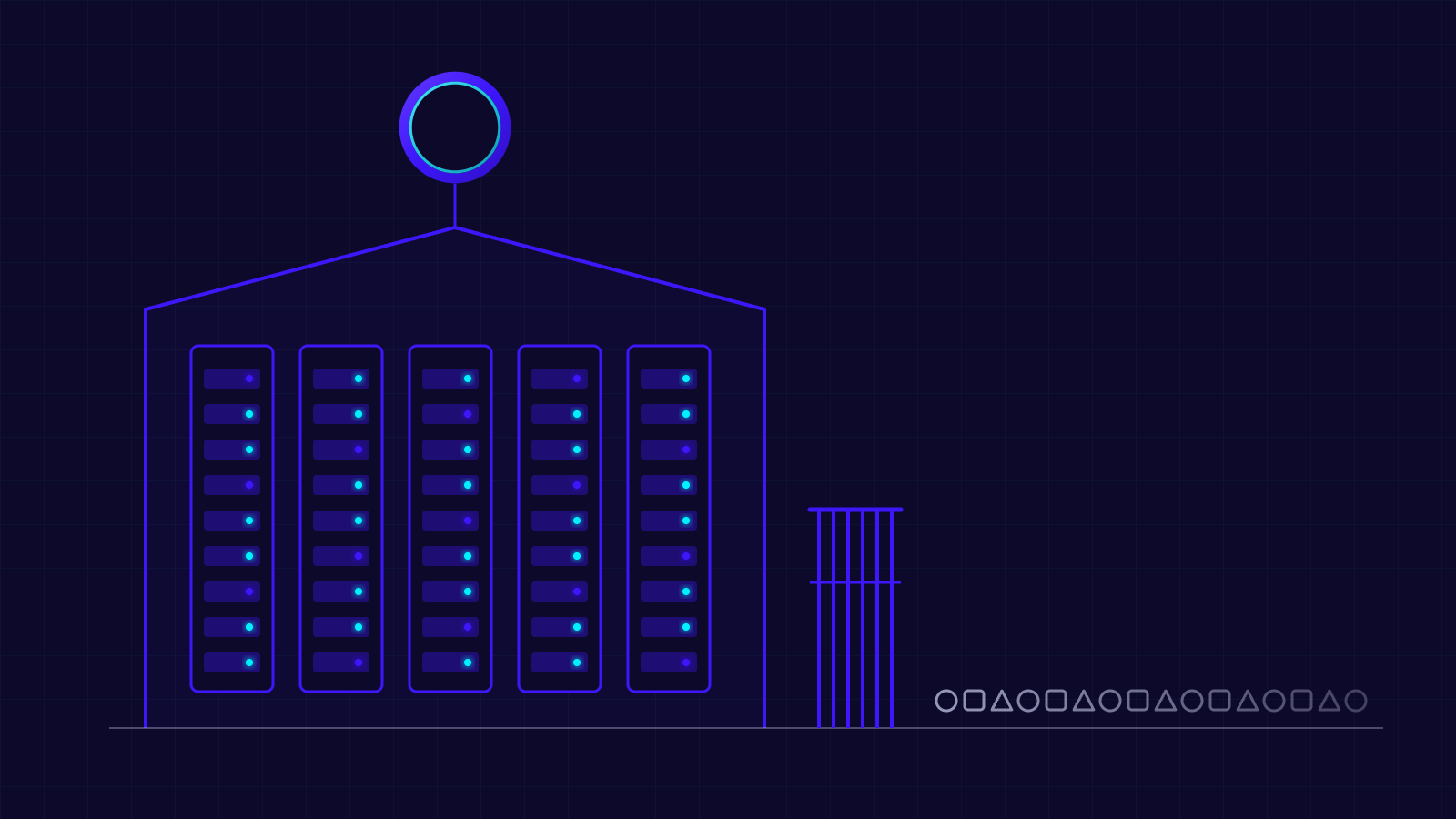
Pricing is following: OpenAI charges a premium for prioritised processing. When supply is fixed, the best models behave like prime-time advertising slots and go to whoever values them most. A company that wants the same model to book flights cannot, and should not try to.
Two ways to get it wrong
A company that sends everything to the best model has two problems.
It overpays, and the bill keeps growing. Newer "agentic" AI systems, which carry out multi-step jobs on their own, use 100 to 1,000 times more tokens per task than a chatbot, by Apollo's estimate. Gartner predicts that over 40% of agentic AI projects will be cancelled by the end of 2027, with escalating costs the first reason it gives.
Or it cannot get the model at all. In a capacity-constrained market, low-value users are the first to be rate-limited, queued or priced out.
The fix for both is the same: use the scarce, expensive model only where the task justifies it, and run everything else on the cheapest model that does the job well. UC Berkeley researchers showed that sorting work this way can more than halve costs with little loss of quality. Yet most companies simply upgrade to their provider's newest model.
Why companies need a control plane
A large company runs thousands of AI tasks, and the frontier moves every quarter, so this cannot be done by hand. A control plane works like the triage desk in a hospital: the senior surgeon's time is scarce, so triage makes sure she sees the cases where her skill changes the outcome. A control plane has four jobs:
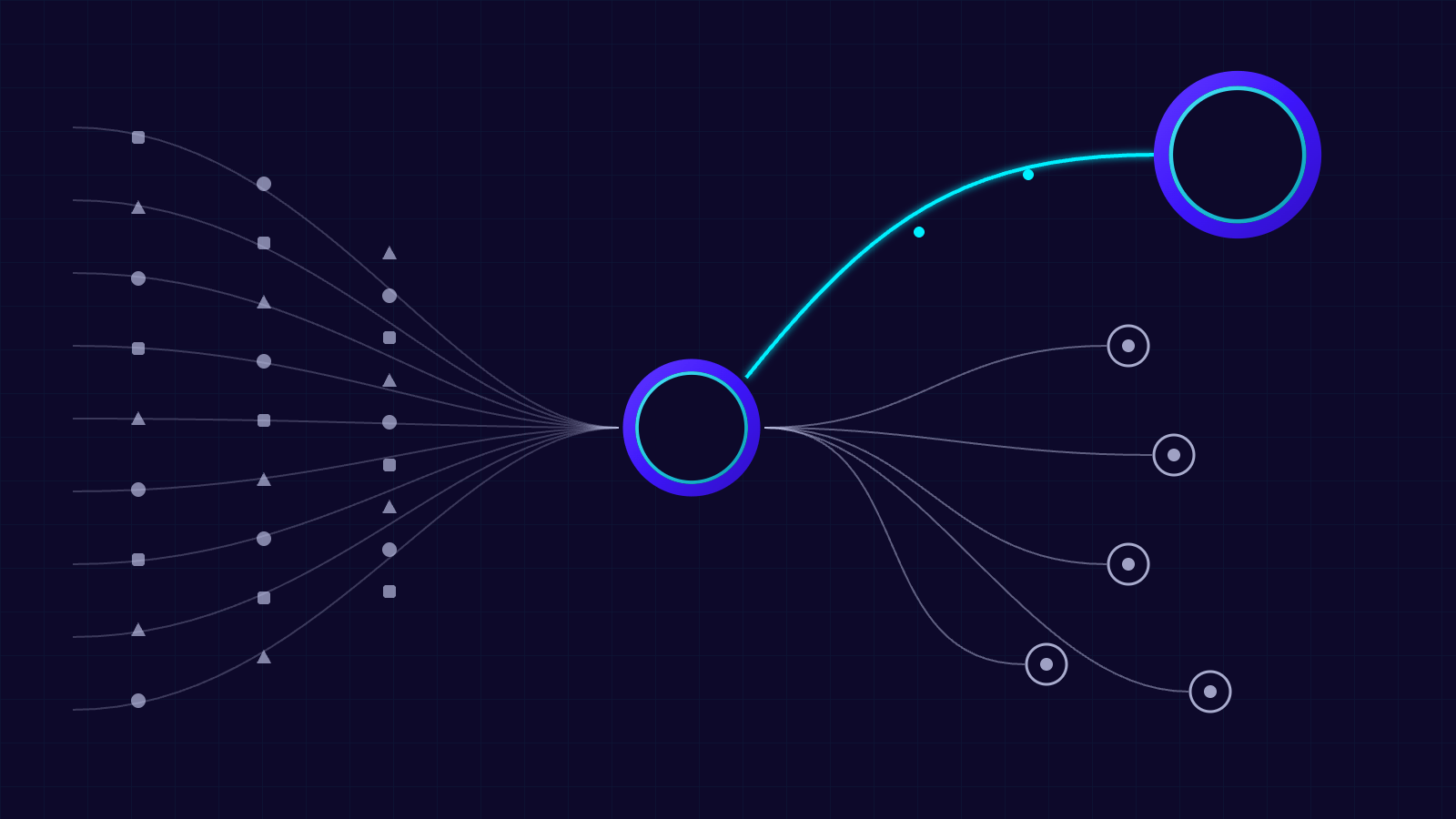
Value the task: what is a right answer worth, and what does a wrong one cost?
Pick the model: the cheapest one on the frontier that clears that bar.
Keep it running: set budgets, switch when a model is unavailable, and record which model did what so the work can be audited.
Keep re-deciding: with costs falling 13 times a year, today's frontier task is next year's routine one.
Where value settles: context
If the best model keeps changing hands and every model keeps getting cheaper, value is likely to move to two places: whoever decides which work goes where, and whoever holds the knowledge that lets a cheaper model do the job well.
That knowledge is context. No public AI model knows which claims a company's legal team approved, in which countries, or what it has already told the market. With that knowledge, a smaller, cheaper model can get right work it would otherwise get wrong. General AI keeps getting cheaper for everyone. Knowledge of one company does not, because it cannot be bought.
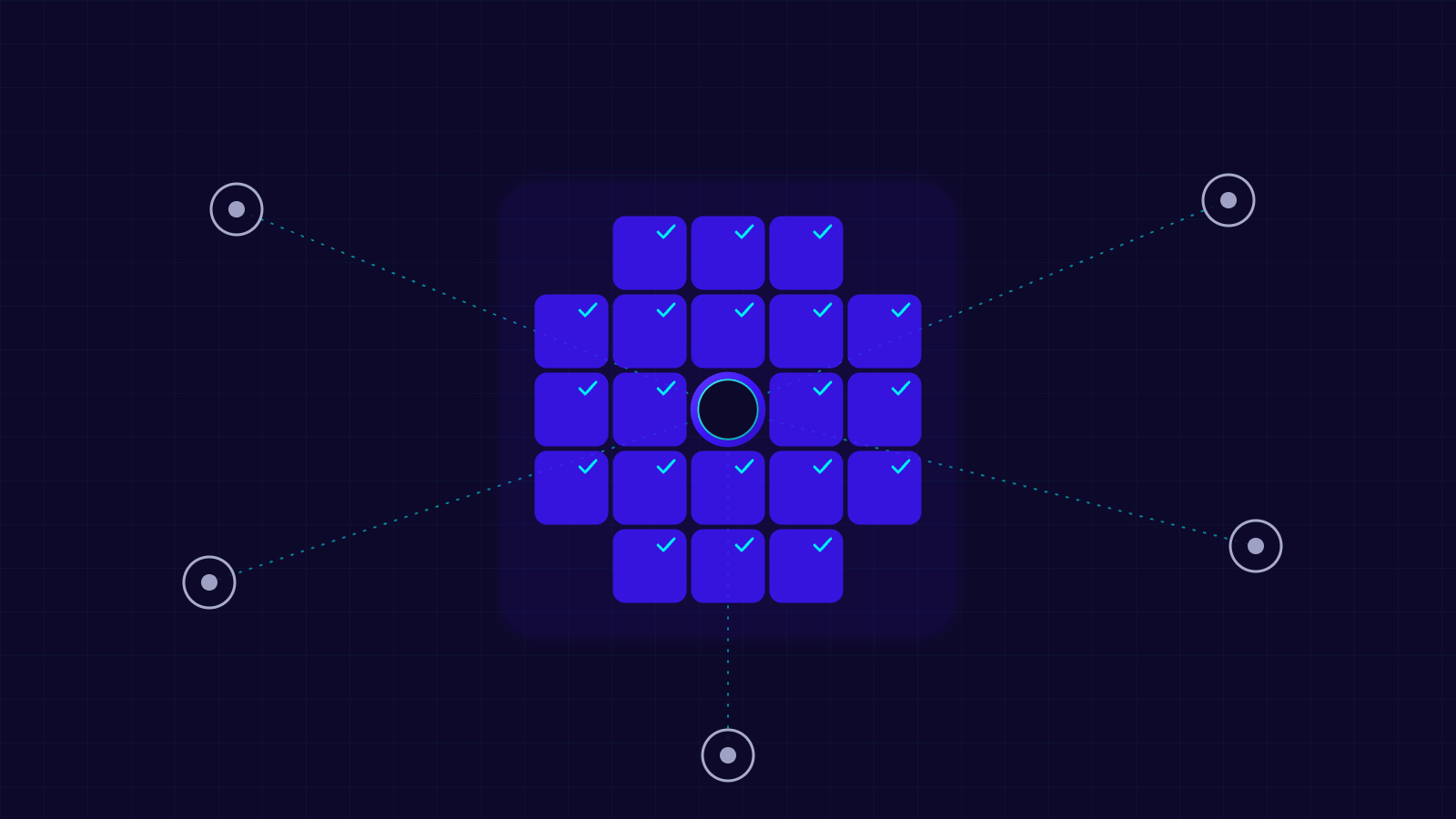
Arbitr applies the same logic to the content a company publishes. It is designed to run each job on our own small specialist models, a frontier model or a customer's own model, drawing on Cortex, which holds each customer's approved knowledge, signed off by a named person. Frontier models and our human specialists can then be kept for the high-stakes work where a mistake costs most.
The market opportunity
Gartner now treats this as a market in its own right. Its August 2026 Market Overview for AI Context Platforms describes software that constructs, governs and delivers reusable context to AI agents, and its forecasts suggest the category is large and growing quickly:
A sizeable new category. AI context platforms are forecast to grow from $28 billion in 2026 to $78 billion in 2030, around 29.5% a year.
Standardisation ahead. By 2028, most enterprises running AI agents in production are expected to standardise on a dedicated context platform, rather than build context agent by agent.
Driven by agents. Spending on AI agents and assistants is forecast to grow from $29 billion in 2026 to $65 billion in 2027.
Better context, better results. By 2027, organisations that prioritise business meaning in their data are expected to improve AI agent accuracy by up to 80% and cut costs by up to 60%.
We see this as the opportunity in front of Arbitr: as models become cheaper and more interchangeable, we believe more of the value in enterprise AI will sit in the verified, company-specific context that makes them reliable.
Thank you for your continued support.
David Sowerby
Co-Chief Executive Officer, Arbitr Group Limited
The Signal — for current and prospective investors in Arbitr Group Limited
Further reading
The plunging price of thought (Epoch AI, Sep 2026). The main study of how fast AI is getting cheaper. Read the key takeaways; the middle is statistics.
The Growing Compute Shortage (Apollo, Jun 2026). Why AI capacity is sold out, from chips to power, and why that lasts years.
2025: The State of Generative AI in the Enterprise (Menlo Ventures, Dec 2025). How about 500 large companies spend on AI and choose their models.
Lack of semantics causes inaccurate AI agents and wasted spending (Gartner, May 2026). A short release on why AI agents need business context to work well.
Market Overview for AI Context Platforms (Gartner, Aug 2026). The source for the market sizing above. Full report available to Gartner clients.